
EN
EN

THz AR Coatings
Product Introduction
As we know, crystalline materials exhibit low transmittance for THz waves due to high reflection losses (the transmittance of HRFZ‑Si is only 54%, while quartz crystal achieves approximately 70% transmittance in the THz band). THz anti-reflection coatings can be applied to mitigate such reflection losses. We offer coatings made of polyethylene and parylene.Our polyethylene coating technology is designed for planar deposition and is typically used on optical windows. Planar parylene coatings are well known in the microelectronics industry. Our parylene can be deposited on both planar and spherical surfaces, making this technique applicable to windows as well as lenses. The high-transmission band can be customized to meet customer requirements. We fabricate custom high-transmission coatings covering wavelengths from 60 μm to 1300 μm.
We provide the following high-transmission coatings:
1.Double-sided AR coating
Commonly used on optical windows or meniscus lenses.
The following wavelength bands are available:
— Polyethylene coating - 60-80 μm, 110-160 μm, 160-220 μm, 320-430 μm, 375-510 μm, 480-650 μm, 535-725 μm, 645-870 μm, 695-940 μm, 965-1305 μm
— Parylene coating 99-125 μm.
HRFZ‑Si substrates accept both polyethylene and parylene coatings, whereas quartz crystals are only compatible with parylene coatings.
With the high-transmission coatings deposited, a transmittance of ≥90% is attainable for the wavelengths listed above.
The figure below shows the transmittance of HRFZ‑Si optical windows with and without polyethylene coatings, as well as quartz crystal optical windows with and without parylene coatings:
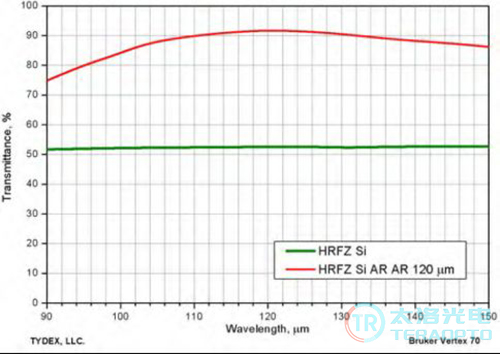
Figure 1.A. Transmission of uncoated and double-side coated HRFZ-Si windows. The AR coating is centered at a wavelength of 120 μm.
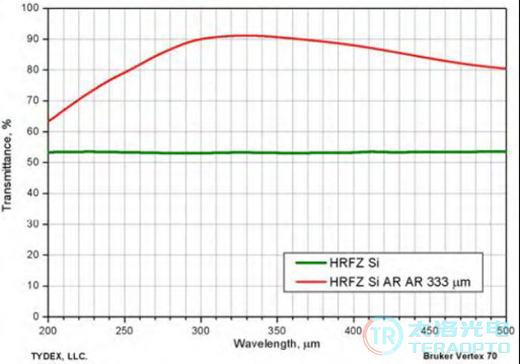
Figure 1.B. Transmission of uncoated and double-side coated HRFZ-Si windows. The AR coating is centered at 333 μm.
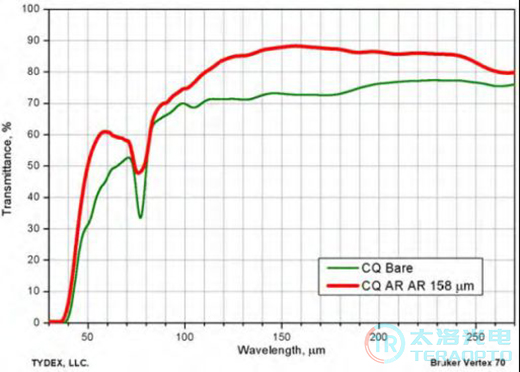
Figure 1.C. Transmission of uncoated and double-side coated quartz crystal windows. The AR coating is centered at 158 μm.
Experiments have verified that parylene-coated products can be used at low temperatures.
The double-side coated quartz crystal window centered at 860 μm underwent thermal cycling with the following parameters:
•Cooled from room temperature to 77 K, 30 cycles,
•Cooled from room temperature to 4.2 K, 3 cycles.
Transmission spectra were measured before and after thermal cycling
(Figure 2A).The surface of the parylene coating was investigated under a microscope.
(Figure 2.B)*.The thin film exhibits no degradation at low temperatures.
The transmittance remains constant.
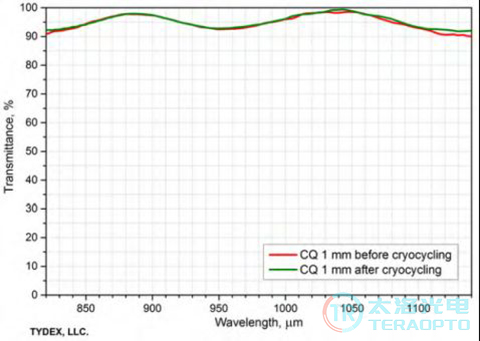
Figure 2.A. Transmission spectra of the double-side coated quartz crystal window before and after thermal cycling.*
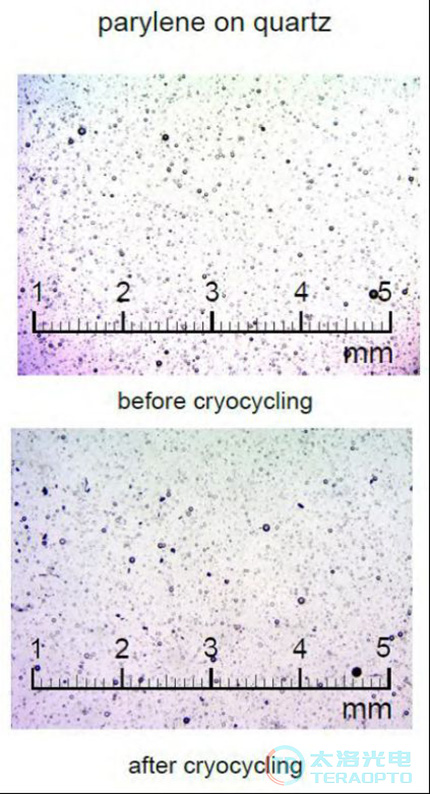
Figure 2.B. Surfaces of the double-side coated quartz crystal window before and after thermal cycling*
*Data provided by Dr. Erik Heinz, Supracon AG, Germany.
2.Single-side AR coating
They are commonly used for hemispherical lenses. The planar surface of the lens remains uncoated because the lens acts as a photoconductive antenna in THz-TDS setups or superconducting bolometers. AR coatings centered at 99 μm to 125 μm have been developed for certain specific applications. The AR coating increases the transmittance of the hemispherical lens by 30%. Owing to the geometry of hemispherical lenses, direct transmission measurement is difficult. We simulated the transmission curves of AR-coated and uncoated lenses (see below). Experimental results obtained by one of our customers confirm an increase in transmittance attributable to the AR coating. When using a single-side coated hyperhemispherical lens, his instrument achieves a power gain of approximately 30–50% at 111 μm.
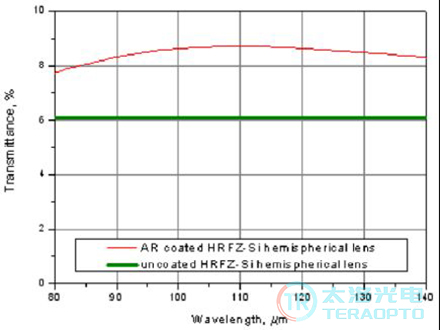
Figure 3. Simulated transmission of uncoated and single-side (spherical surface) parylene-coated hemispherical lenses. The AR coating is centered at wavelengths ranging from 99 to 125 μm.
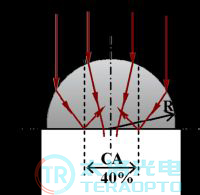
As can be seen, the transmittance of an uncoated HRFZ-Si hemispherical lens is only 6%. This is associated with the total internal reflection effect. The total internal reflection angle is approximately 17°. Owing to the high refractive index of silicon and the lens geometry, most of the THz radiation passing through the lens is reflected at the planar lens surface–air interface. Therefore, the net aperture of the hemispherical lens is only 40%. Considering the special wavelength range required by customers, we manufacture AR-coated windows and lenses on request, and these are generally not available from stock.