
EN
EN
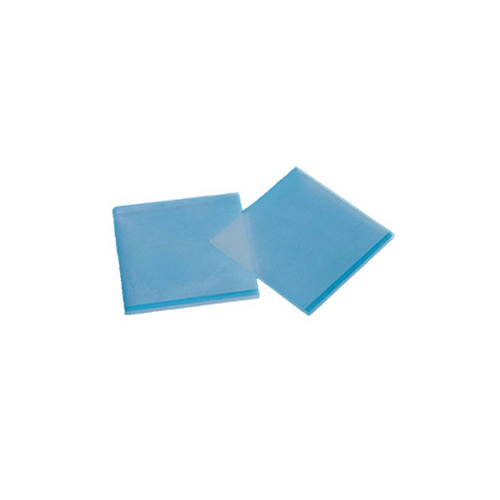
THz Diffraction Gratings, THz Gratings
Product Introduction:
The new product launched by Tydex, the thz diffraction grating, is used for spectral measurement in the thz frequency range. They are convex phase transmittance type gratings. The regular structure of this grating is achieved by cutting parallel grooves on a transparent substrate. The substrate is made of transparent materials for the thz band, such as TPX (polymethylpentene) and ZEONEX (cycloolefin polymer).
Applications of THz Diffraction Gratings:
• THz spectrum;
• THz diagnostic instrument;
• Photoelectric equipment;
• Astronomy and astrophysics applications, including space-based;
• Material research
Performance characteristics of THz Diffraction Grating:
Within the 0.3 - 3THz range, we offer four standard product options for thz gratings: 0.28 - 0.55THz; 0.49 - 0.98THz; 0.87 - 1.75THz; 1.56 - 3.12THz. Gratings within the 0.3 - 3THz range for other frequencies can be produced according to customer requirements.
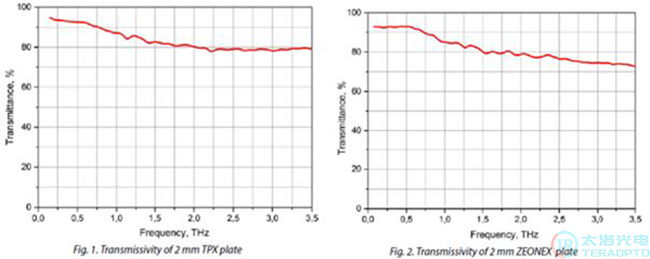
The transmitted spectra of the TPX and ZEONEX plates after polishing on both sides before the cutting groove are shown in the following figure.
THz gratings are usually made in a square shape, with the side length typically ranging from 35mm to 70mm. Other shapes and sizes can be provided upon request.
Depending on the intended application, thz diffraction gratings can be used in various thz optical experiments with or without focusing lenses.
We calculated the grating parameters, diffraction wave intensity and the first-order maximum angle of monochromatic light using the Fraunhofer approximation method.
To verify the operation and compare the simulated calculations with the actual measured parameters, we measured the characteristics of the thz grating under different thz radiation sources. Two sources were used. The first one was a far-infrared laser, which is a sub-millimeter methanol vapor laser pumped by a tunable CO2 laser (Peter the Great St. Petersburg Polytechnic University). The second one was a free electron laser (FEL), a free electron laser (Siberian Synchrotron and THz Radiation Center, Budker Institute of Nuclear Physics, RAS). Figures 3 and 4 depict the relationship between the monochromatic wave intensity (λ = 118 μm) of the TPX and ZEONEX gratings with the diffraction angle when using the FIR laser as the radiation source with a spacing of d = 250 μm. Figures 5 and 6 present the influence of the monochromatic wave intensity (λ = 141 μm) on the diffraction angle. In the second case, a convergent lens was placed between the grating and the radiation detector. The comparison of these figures indicates that in the first case, the maximum values of the zeroth and first-order orders are wider in the path without the lens compared to the path with the lens. This is the result of the convergent lens focusing the parallel beam. Users must take this into account when designing experiments according to their intentions. When the grating is used to study the characteristics of the radiation source (power, beam shape, energy distribution, etc.), the lens is redundant. But when spectral lines need to be resolved, the lens becomes indispensable.
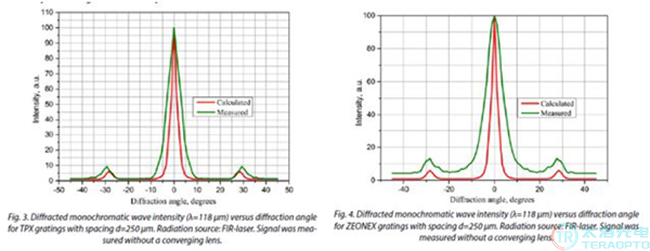
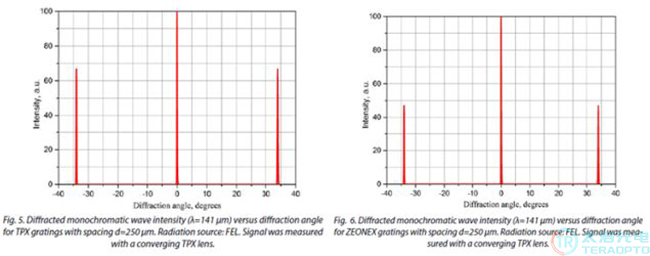
For the diffraction gratings that use the Rayleigh criterion to determine a specific transmittance band, the intensity of the diffraction monochromatic waves is related to the wavelength. It reaches its maximum in the middle of the curve and decreases near the boundaries. For example, the results of Data 3-6 show that for the TPX and ZEONEX diffraction gratings with a spacing of 250 μm (the transmittance band is 1.56 ~ 3.12 THz or 96 ~ 192 μm), the first-order maximum intensity of the monochromatic wave with λ = 141 μm is several times that of the monochromatic wave with λ = 118 μm. (The first one is in the middle of the transmittance band, while the second one is closer to the edge.) It matches the theoretical diffraction wave intensity of the monochromatic wave calculated using the Fresnel approximation. Due to the different radiation sources and optical experimental configurations used when testing the gratings, the intensities below are given in arbitrary units.
The research data indicate that this method has high optical efficiency and the highest resolution of the calculation result. Therefore, this grating can be effectively used to study the spectrum of radiation sources, including low-power sources, which is an important capability for researching the thz frequency range.