
EN
EN
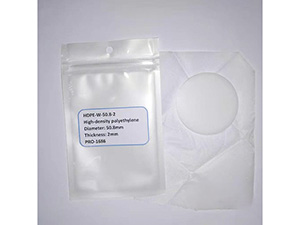
HDPE Window
Polyethylene (PE)Product Introduction
PE is a lightweight, elastic crystalline material. It can be heated up to 110°C and cooled down to-45 ÷ -120°C. PE exhibits good dielectric properties, corrosion resistance, and radiation resistance. However, it is not stable under ultraviolet light or in oily environments. Biologically, PE is inert and easy to handle. At 23°C, its density ranges from0.91-0.925 g/cm3, tensile strength is between8-13 MPa, elastic modulus lies within 118–350 MPa, and its refractive index is approximately 1.54 across a wide spectral range. High-density polyethylene (HDPE) is commonly used as a component material. Besides serving as thick lenses and window materials, thin HDPE films can also function as THz polarizers. We use HDPE as the window material for Golay Cell.
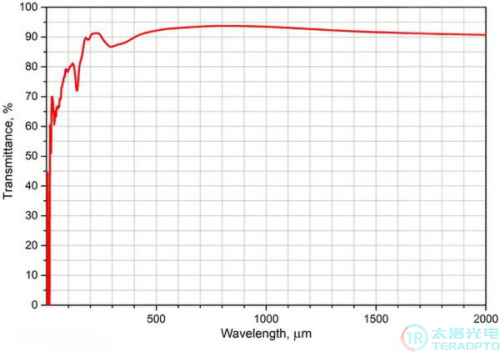
Fig. 1 Transmittance of 2 mm-thick HDPE sample. THz region.
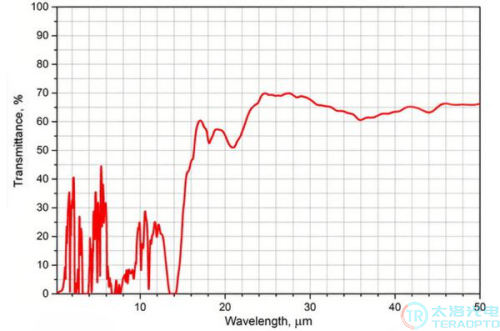
Fig. 2 Transmittance of 2 mm-thick HDPE sample. NIR&MIR region.
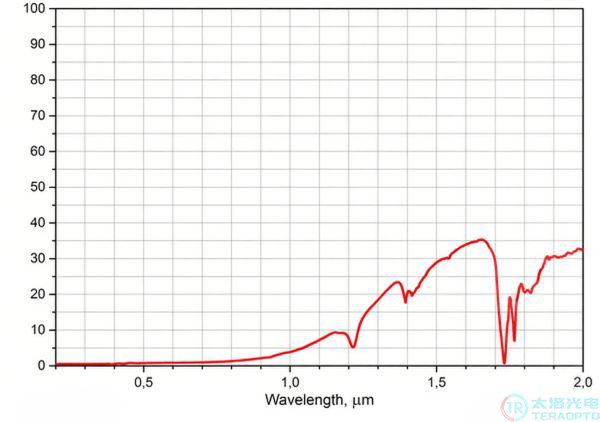
Fig. 3 Transmittance of 2 mm-thick HDPE sample. VIS&NIR region.
Regrettably, the transmittance of HDPE to visible light is extremely low, so it cannot be used as a collimating element in an optical system.
We should also note that the THz transmittance of HDPE does not depend on temperature, and thus can be used as a window mirror for a low-temperature stabilizer. The temperature coefficient of the refractive index is 6.2*10-4 K-1 (for the range 8-120 K).
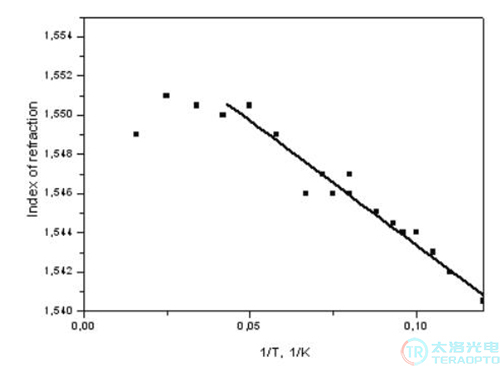
Fig. 4 Temperature dependence of refractive index (***)
HDPE Window product model:
Model | Diameter(mm) | Thickness(mm) |
HDPE--W-D25.4-T1 | 25.4 | 1 |
HDPE--W-D25.4-T2 | 25.4 | 2 |
HDPE--W-D25.4-T3 | 25.4 | 3 |
HDPE--W-D25.4-T4 | 25.4 | 4 |
HDPE--W-D25.4-T5 | 25.4 | 5 |
HDPE--W-D50.8-T1 | 50.8 | 1 |
HDPE--W-D50.8-T2 | 50.8 | 2 |
HDPE--W-D50.8-T3 | 50.8 | 3 |
HDPE--W-D50.8-T4 | 50.8 | 4 |
HDPE--W-D50.8-T5 | 50.8 | 5 |
Other specifications can be customized according to your requirements