
EN
EN
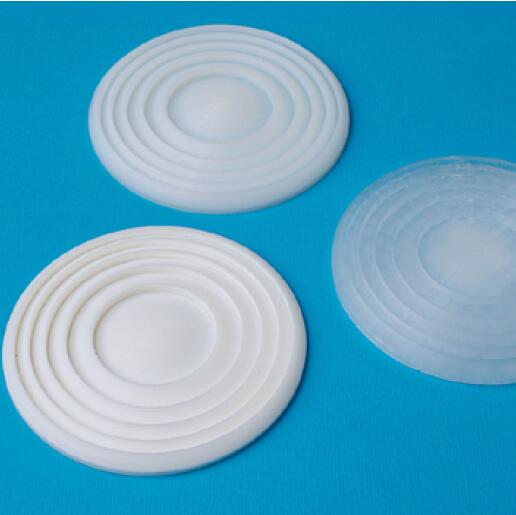
Controlling the light beam is essential in many terahertz (THz) applications. Currently, it is achieved through parabolic mirrors and refractive optics.
However, diffraction optics possesses a revolutionary capability as it can be utilized for the spatial transformation of light beams. To meet the requirements of diffraction optics operating in the terahertz range, we have developed a method for calculating and manufacturing terahertz Fresnel lenses.
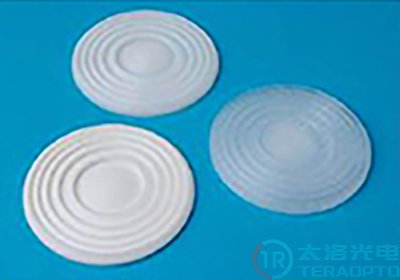
Monochromatic Fresnel lenses made of various thermoplastic materials(COC,PLA,HIPS)
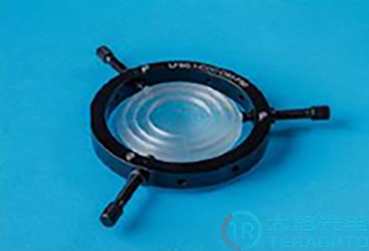
A broadband Fresnel lens made of COC thermoplastic material
The Fresnel lens developed by Tydex has multiple layers of concave and convex surfaces, closely approximating the ideal phase function of the diffraction point concentrator. The micro-concave and convex profiles of single-color Fresnel lenses and broadband Fresnel lenses have different thicknesses. The single-color terahertz Fresnel lens is a first-order frequency element and can operate at the rated frequency, multiples of the rated frequency, and a wide range of high frequencies. The broadband terahertz Fresnel lens is of a higher order and has a wide working range that can be adjusted to be close to the rated frequency.
Therefore, the monochromatic terahertz Fresnel lens is the most suitable for effectively controlling continuous terahertz radiation beams. The broadband terahertz Fresnel lens can be used to control pulsed terahertz radiation. Both of these terahertz Fresnel lenses are made of thermoplastic polymers of cycloolefin copolymer (COC). However, the design work for monochromatic terahertz Fresnel lenses operating at 0.3 terahertz and below can also be produced using HIPS and PLA. The main advantage of the Fresnel lens over the refractive lens is that it has almost zero spherical aberration, as well as lower thickness and quality for large-diameter beams. The latter provides higher radiation resistance due to the lower internal absorption of the lens.
General Specifications:
| Parameter | THz Fresnel Lenses |
| Material | COC(or HIPS,PLA) |
| Diameter(mm) | Up to 150 |
| Thickness(mm) | 1-10 |
| operation wavelength range,THz | 0.1-1.5 |
| diffraction efficiency*,% | 100** |
| Focal Length,mm | 10-150 |
| Focal Length Tolerance,% | ≤5 |
*The diffraction efficiency is the ratio of the power of the light beam that is diffracted into the specified area to the total power of the incident light beam.
**At the rated terahertz radiation frequency and its multiples.
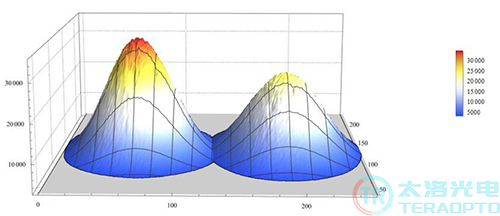
The intensity distribution of the light beam focused by the monochromatic terahertz Fresnel lens (on the left) and the refractive lens (on the right).
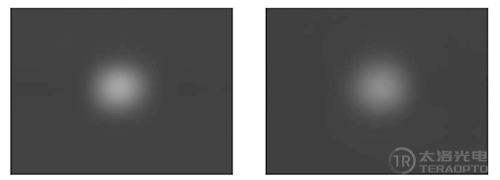
The radiation intensity distribution of the original image is formed by a single-color focused terahertz Fresnel lens (on the left) and a refractive lens (on the right).
Monochromatic terahertz Fresnel lenses are more effective in focusing terahertz radiation than refractive lenses. The comparison of the intensity of the focused radiation by diffraction Fresnel lenses and TPX refractive lenses is shown in the figure above (on the left is the Fresnel lens, and on the right is the TPX lens).
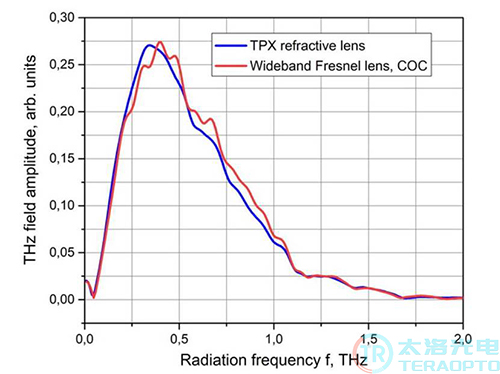
Comparison of the amplitude spectra of the focused light beam fields of lenses.
The broadband terahertz Fresnel lens can focus terahertz radiation with an efficiency at least as high as that of a refractive lens. The intensity of the focused radiation by the Fresnel lens (rated frequency 1 THz, focal length 90 mm, lens diameter 93 mm) is compared with that focused by the TPX refractive lens as shown in the figure.
Terahertz Fresnel lenses can be manufactured according to the specifications of customers.