
EN
EN
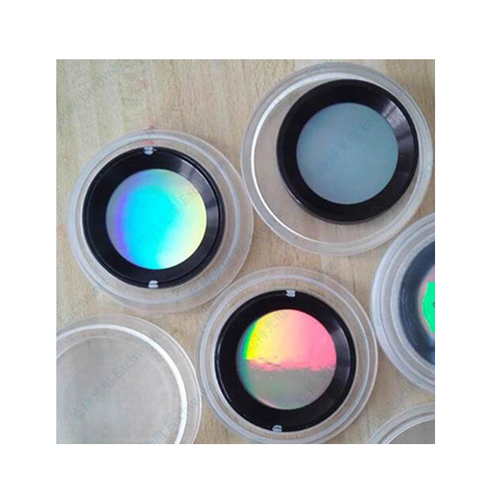
THz polarizers; THz polarizers; THz thin-film polarizers
Product Introduction
We offer two types of polarizers, designed for the far-infrared and terahertz spectral ranges respectively, both fabricated from polypropylene film as the substrate. The film surface features sinusoidal grooves, with certain groove areas coated with an aluminum layer, ultimately endowing the terahertz polarizer with the characteristics of a transmission grating.
一、Two Specifications of Terahertz Polarizers
We employ two slightly different manufacturing processes to produce polypropylene terahertz polarizers, with the key distinction lying in their light-transmitting aperture size:
1,Develop a terahertz polarizer with an output light aperture ranging from 25 mm to 45 mm.
2,Develop terahertz polarizers with an output light aperture ranging from 50 mm to 100 mm.
There are subtle differences in the performance of the two types of polarizers, primarily manifested in their polarization transmission rates along the orthogonal alignment direction and the resulting extinction ratios, with these differences being more pronounced across the long-wavelength range.
二、Transmission Spectral Measurement of Terahertz Polarizers
We employed two distinct instruments to conduct terahertz polarizer transmission spectroscopy measurements, with the specific coverage ranges and equipment specifications as follows:
1,0.9~670 μm (corresponding frequency 333.1~0.45 THz), using a Bruker VERTEX 70 Fourier transform infrared spectrometer.
2,150~3000 μm (corresponding to a frequency of 2~0.1THz), using the TERA-K8 terahertz time-domain spectrometer from Menlo Corporation. This equipment is equipped with μm dipole antennas and has a center frequency of 0.5 THz.
The measurement results are shown in Figures 1 and 2.
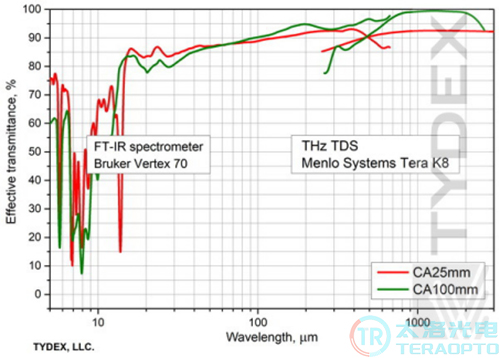
Figure 1 Shows the Transmittance of Polypropylene Terahertz Polarizers With Aperture Sizes of 25 mm and 100 mm in the Polarization Direction.
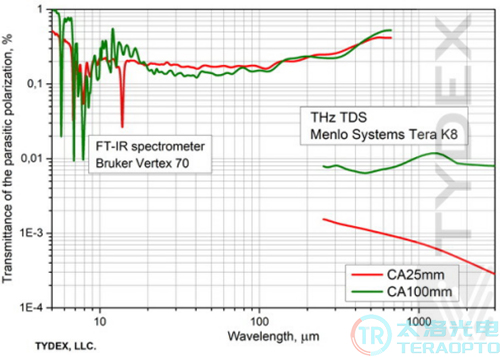
Figure 2 shows the transmittance of polypropylene terahertz polarizers with 25 mm and 100 mm apertures in the polarization orthogonal direction.
The gap between the transmittance curves in this direction results from differences in the spectrometer's dynamic range (DR), which affects noise levels. The Bruker VERTEX 70 Fourier transform infrared spectrometer exhibits a peak dynamic range of 40 dB in the short-wavelength range (4–5 μm); however, its dynamic range narrows to only 22–20 dB across the 15–100 μm range, decreasing progressively with increasing wavelength.
The Menlo TERA-K8 terahertz time-domain spectrometer offers a dynamic range of 60 dB for electric field amplitude measurement across a wavelength range of 600 μm. Consequently, the transmittance curves in polarization orthogonal directions exhibit significantly lower values within the 300–3000 μm range and are closer to actual measurements.
The figure below illustrates the polarization degree and extinction coefficient of the emitted radiation. Both parameters are determined based on the transmittance values in the polarization direction and the orthogonal direction to it. For these reasons, the values calculated from each spectrometer set of data differ by several orders of magnitude.
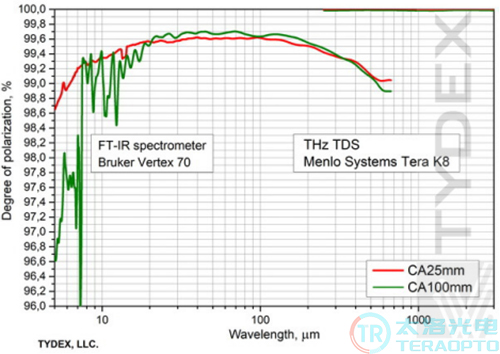
Figure 3: Polarization Degree of Polypropylene Terahertz Polarizers With Apertures of 25 mm and 100 mm
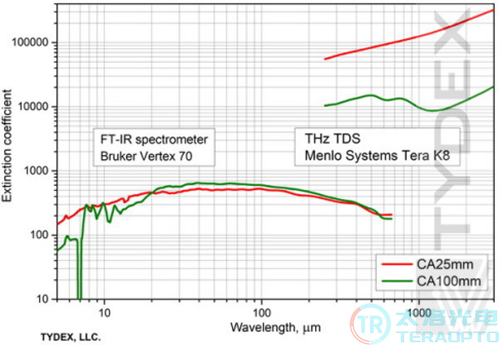
Figure 4: Absorption Ratios of Polypropylene Terahertz Polarizers With Aperture Sizes of 25 mm and 100 mm
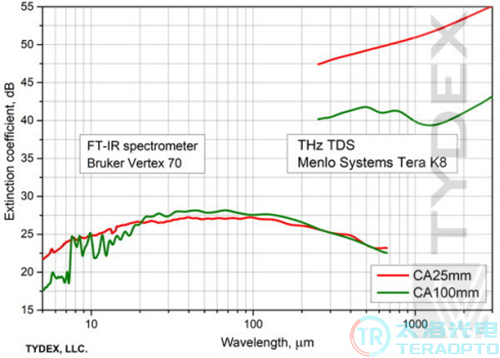
Figure 5 shows the extinction coefficients (in dB) of polypropylene terahertz polarizers with aperture sizes of 25 mm and 100 mm.
The curves above demonstrate that our terahertz polarizers exhibit excellent performance across an extremely wide wavelength range. Note that actual measured values may differ from these figures depending on the spectrometer model and measurement mode.
Typical model specifications of polypropylene terahertz polarizers
Product name | Model | Outer Diameter Dimension | Clear aperture | Edge thickness |
Polypropylene terahertz polarizer | POL-PP-CA25-OD40-T8 | 45mm | 25mm | 8mm |
Polypropylene terahertz polarizer | POL-PP-CA30-OD50-T10 | 50mm | 30mm | 10mm |
Polypropylene terahertz polarizer | POL-PP-CA38-OD60-T10 | 60mm | 38mm | 10mm |
Polypropylene terahertz polarizer | POL-PP-CA45-OD70-T10 | 70mm | 45mm | 10mm |
Polypropylene terahertz polarizer | POL-PP-CA45×45-OD85-T10.5 | 85mm | 45*45mm | 10.5mm |
Polypropylene terahertz polarizer | POL-PP-CA51-OD76-T12 | 76mm | 51mm | 12mm |
Polypropylene terahertz polarizer | POL-PP-CA77-OD101-T12 | 101mm | 77mm | 12mm |
Polypropylene terahertz polarizer | POL-PP-CA102-OD124-T12 | 124mm | 102mm | 12mm |
Technical Parameters of Terahertz Polarization Films
Backing material | Polypropylene | |
Applicable wavelength | ≥15um | |
Aperture | 25mm-50mm | 50-100mm |
Effective Transmittance | >80 @15-3000 μm | |
Scale Density | 1200/mm | |
Transmittance in the orthogonal polarization direction,% | 0.2 @15 μm | 0.3 @15 μm |
Polarization degree (K1-K2)/(k1+k2),% | 99.5@15 μm | 99.3 @15 μm |
Extinction ratio E=K1/K2,% | >350 @15-250 μm | >250 @15-250 μm |
Extinction ratio,dB | >25@15-250 μm | >24@15-250 μm |
Terahertz Polarizer Applications:
—Terahertz spectroscopy;
—Terahertz imaging;
—Molecular orientation of crystals and polymer films;
—Fourier transform infrared spectroscopy;
—Sensor。
Characteristics of terahertz polarizers:
√ Suitable for a very wide range of wavelengths15um - 3mm;
√ The substrate material is high-density polyethylene;
√ High infrared transmittance;
√ High degree of polarization;
√ The terahertz polarizer comes with a mount
A mid-infrared polarizer is also available.
>>Download THz Polarizers Datasheet (PDF, 69 KB)