EN
EN
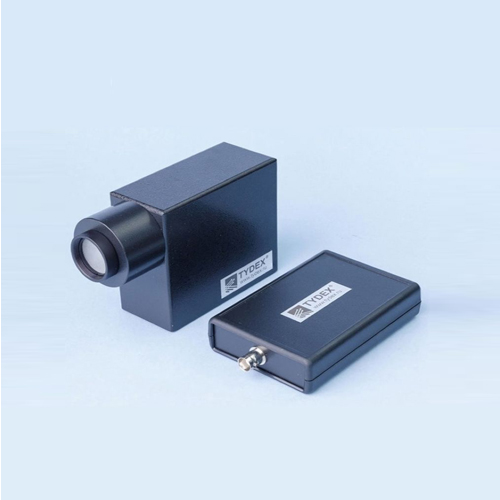
Golay Cell Detector THz Detector GC-1P
Product Introduction
Russia's Tydex Company was founded by former scientists from the Yofe Institute of Physics and Technology at the Russian Academy of Sciences. The company specializes in custom manufacturing of THz detectors and optical components. The Golay Cell detector is one of the most effective THz detectors, offering excellent sensitivity at room temperature and a flat optical response across a wide wavelength range. The Golay Cell series of THz detectors are manufactured in-house and independently calibrated; each unit includes a probe, power supply, and data acquisition module, with optional filter mounts available. Various THZ optical components fabricated from HRFZ-Si and TPX materials—such as low-pass filters, polyethylene polarizers, window mirrors, lenses, and splitters—are designed for diverse THz applications. We also provide hardware and software solutions to convert analog signals generated by Golay Cell detectors into digital signals, comprising specialized software and a circuit module that can be connected to personal computers via USB cables for detecting, processing, and analyzing photoacoustic signals.
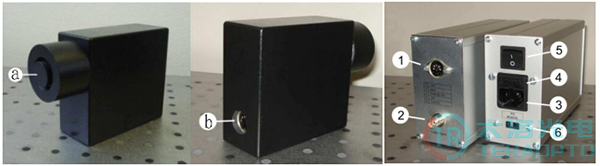
a) Incidence cone and incidence window; b) Socket for connecting to the GC-PS/1;
1) Connect to the Golay Cell socket; 2)Connect to the signal output socket of the Golay Cell; 3)Connect to the power cord socket; 4)Install a fuse; 5)Turn on/off the switch; 6)Select voltage: 230 V or 115 V
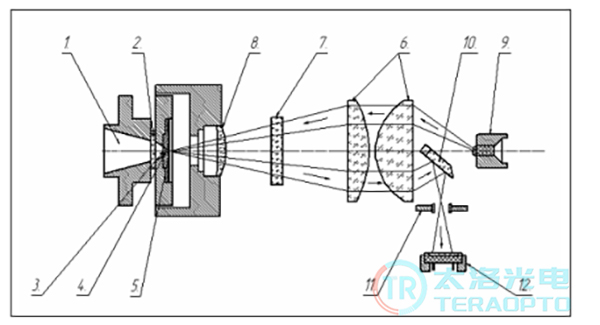
Introduction to the Golay cell principle:
The modulated incident light beam passes through the incident cone 1 and the incident window 2, reaching the center of the semi-transparent film 3 chamber. The energy absorbed by the film heats the gas within the chamber; the resulting gas expansion pressure induces a corresponding modulation oscillation frequency. This oscillation frequency is transmitted via path 4 to the mirror film 5 (the chamber wall), which also serves as a reflective surface for the optical microphone. The photodiode 9, functioning as the optical microphone, emits the projected image. The light passes through the condenser 6 made of the mirror film and the upper portion of the fiber grating 7, with its grating positioned on the focal plane of lens 8. After reflection by the mirror film 5, the reflected light travels through the lower half of the fiber grating 7, then passes through the reflective mirror 10 and the vibration plate 11, and is finally focused onto the photodiode 12. This occurs because changes in gas pressure cause membrane vibration, causing the light emitted from photodiode 9 to pass periodically through the lower half of the grating and ultimately focus onto the photodiode.
The preamplifier consists of an operational amplifier and two FETs, designed to convert oscillating photocurrent into an AC electrical signal. The load resistor of the photodiode is connected to the amplifier's negative feedback circuit. A voltage for the input signal is delivered via a connecting cable to an external recording and/or display device.
Introduction to Golay Cell Usage:
Since the Golay Cell terahertz detector is designed to process sine-modulated signals, an optical chopper is required to modulate the incident light signal. The optical chopper must be prepared and activated in advance (refer to the operational instructions for the optical chopper).
The classical single-beam experiment proceeds as follows: A light source emits a single beam of light, which is modulated by an optical chopper blade. The modulated beam reaches the incident cone of the Golay Cell terahertz detector, passes through the incident window, and is subsequently detected. Depending on the experimental requirements, the modulation frequency may be constant or variable during the experiment. In the latter case, connecting the chopper to a recording and display system enables real-time recording of the detector's frequency-response signal.
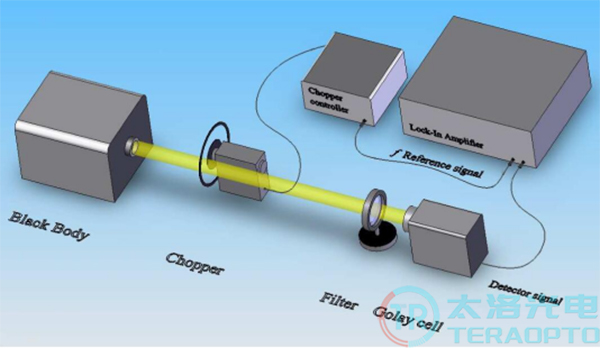
Specifications of Golay Cell Terahertz Detector:
Specification Item | GC-1P | GC-1T | GC-1D | |
Application: Radiation Monitoring and Control | Mid-infrared (MIR) and terahertz (THz) radiation | Ultraviolet–Near Infrared (UV-NIR) and Terahertz (THz) radiation | As can be seen – Terahertz (VIS-THz) Radiation | |
Incidence window material | High-density polyethylene(HDPE) | Polydimethylpentene(TPX) | Diamond | |
Working wavelength range,μm | 15 ~ 8000 | 0.3 ~ 6.5 & 13 ~ 8000 | 0.4 ~ 8000 | |
Incidence cone diameter,mm | 11.0 | |||
Incidence window diameter,mm | 6.0 | |||
Recommended detection power,W(not exceeding) | 1×10⁻⁵ | |||
Recommended High-Power Terahertz Attenuators | ATS-5-25.4, ATS-5-50.8 | |||
Optimal modulation frequency,Hz | Typical Case | 1.4×10⁻¹⁰ | ||
Minimum | 0.8×10⁻¹⁰ | |||
Optical Responsivity @15Hz,V/W | Typical Case | 1×10⁵ | ||
Maximum | 1.5×10⁵ | |||
Response speed,ms | Typical Case | 30 | ||
Minimum | 25 | |||
Detection rate at the aperture of the incident cone(D*), cm×Hz¹ʹ²/W
| Typical Case | 7.0×10⁹ | ||
Maximum | 11.0×10⁹ | |||
Environmental pressure range,mm Hg | 760~10⁻³ | |||
Working and storage temperature range,℃ | 5÷40 | |||
Humidity,% | 0~80 | |||
Vibrate | Avoid vibrations at 1~100 Hz | |||
Rated voltage,VAC | 100/115±10%,220/230±10% | |||
Line frequency,Hz | 50~60 | |||
Total dimensions,length × width × height,mm | 126×45×87 | |||
Weight,kg | 0.8 | |||
Golay Cell Detector response versus modulation frequency curve:
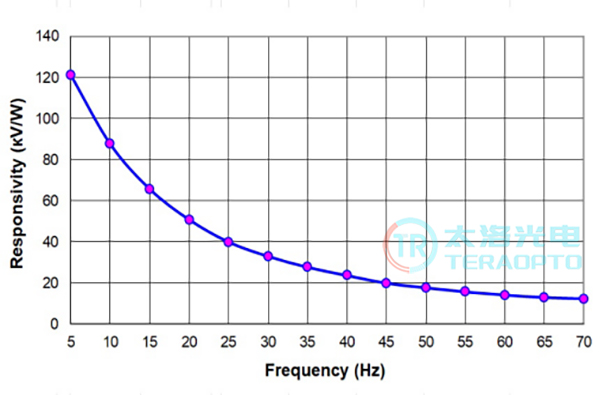
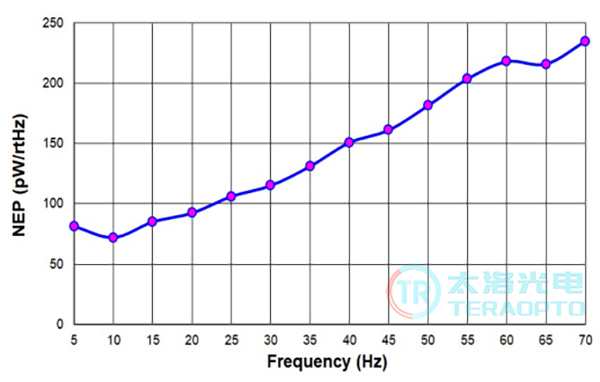
Golay Cell Detector NEP vs Modulation Frequency Curve: