EN
EN
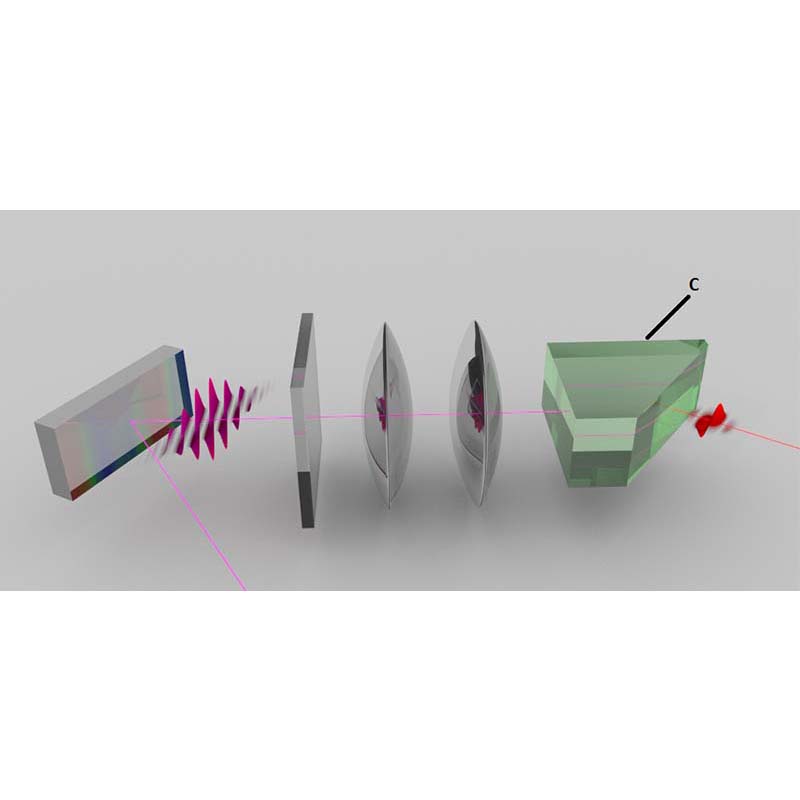
Lithium Niobate Crystal,MgO:LiNbO3
Product Introduction
As research on THz sources continues, new sources are increasingly evolving toward broader spectral ranges and higher pulse energies. For instance, the air method generates intense THz radiation by ionizing air with femtosecond lasers; four-wave mixing can produce THz spectra reaching tens of THz, with peak intensities up to MV/cm². In 2002, J. Hebling et al. proposed a wavefront tilt technique: by tilting the pulse laser's wavefront incident on a prepared lithium niobate crystal, they achieved velocity matching between THz and femtosecond lasers along the emission path, thereby overcoming the constraints of tight-binding conditions and generating powerful THz pulses.
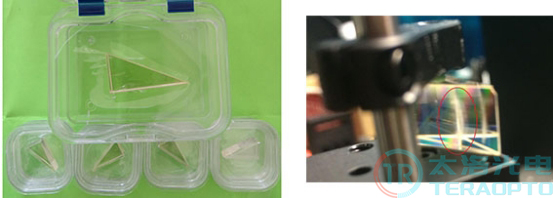
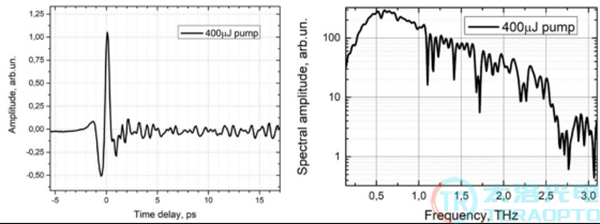
The terahertz radiation generated by wavefront tilt in lithium niobate crystals exhibits pulse and spectral characteristics, with the detection crystal being a 1 mm thick[110]cut ZnTe crystal.
Specifications and Parameters of Lithium Niobate Crystal
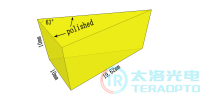
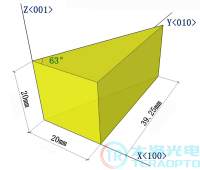
Model | Incidence Surface Dimension | Incidence surface anti-reflection coating | Angle of wedge | Diagrammatic sketch |
MgO(1%)- LiNbO3- 10x19.62x10-700-1100 | 10mm*10mm | 700nm-1100nm | 63° |
|
MgO(1%)- LiNbO3- 20x39.25x20-700-1100 | 20mm*20mm | 700nm-1100nm | 63° |
|
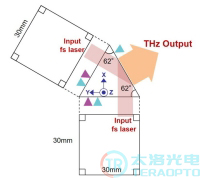
MgO(1.3%)- LiNbO3- 30×30 | 30mm*30mm (can be used for double-sided incidence) | 700nm-1100nm
| 62° |
|
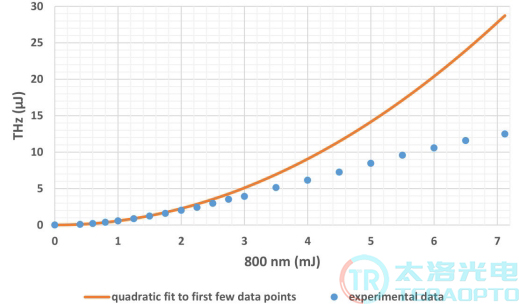
Lithium niobate crystals with tilted wavefronts exhibit terahertz conversion efficiency (conditions: room temperature; crystal type:MgO(1%)- LiNbO3-10x19.62x10-700-1100 ).
Placing these crystals in a liquid nitrogen cryostat significantly enhances terahertz generation efficiency.
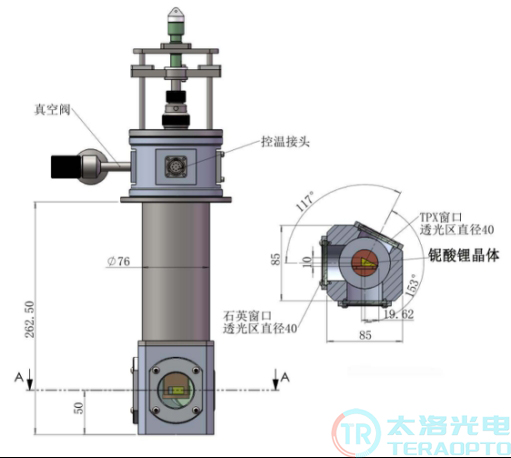
Design diagram of a low-temperature thermostat for housing lithium niobate crystals.